Punctuality Matters: Why Manual Attendance Tracking Doesn't Scale for Nepali Employers
Context
Most Nepali SMEs with field staff, multiple branches, or factory floors track attendance through manual registers, biometric machines whose data nobody reconciles promptly, or a supervisor’s WhatsApp message confirming who showed up that day. None of these tell HR, in real time, who’s late, whose overtime claim doesn’t match actual hours worked, or which branch has a chronic punctuality problem.
The Problem
Without a system, attendance discrepancies surface at the worst possible time — during payroll, when a late-arrival penalty or an overtime claim doesn’t match what the supervisor remembers approving. For field staff and project-site teams there’s an added layer: there’s often no reliable way to confirm someone actually checked in at the client site versus marking themselves present from home. Multiply this across branches and shifts, and the picture HR has of company-wide punctuality is, at best, a rough estimate compiled days after the fact — too late to address the pattern, and too vague to act on fairly.
The Best Practice
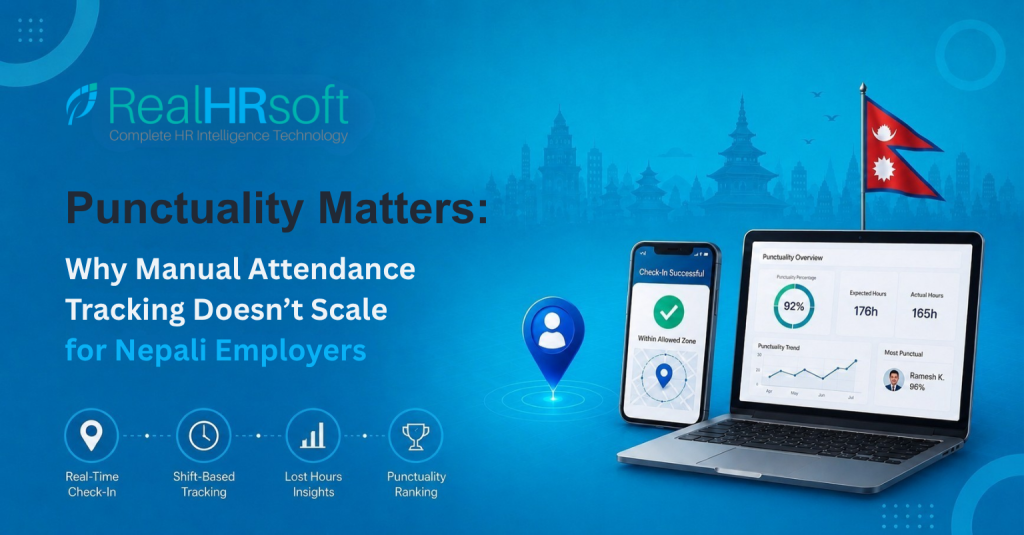
The fix isn’t stricter rules — it’s accurate, real-time data tied to where and when someone actually checked in, measured fairly across different shifts. RealHRsoft calculates a Punctuality Percentage for each employee from their punch-in time against their own allocated shift start time — so someone on a 6 AM shift and someone on a 10 AM shift are each scored against their own schedule, not one company-wide cutoff that quietly penalises early shifts. The Attendance Module also tracks Expected Working Hours against actual hours worked, surfacing Lost or Surplus Hours directly. That distinction matters: a presence count tells you who showed up, but Lost Hours tells you how much productive capacity actually walked out the door — a very different number for workforce planning and cost control.
This data is useful in two directions, and most attendance content only talks about one of them. On the corrective side, Lost Hours feeds directly into Attendance Penalty settings, so deductions are based on an objective figure instead of a supervisor’s memory of who was late. On the recognition side, RealHRsoft surfaces a Most Punctual Employee ranking — sortable to show the least punctual too — which gives HR something to actually celebrate, not just enforce. Reports can be pulled as a single snapshot or compared across a quarter, half-year, or full year, which matters because one late day says very little — a pattern across a quarter says a lot, whether that pattern is a chronic latecomer or a genuinely reliable employee worth recognising in front of the team. RealHRsoft’s biometric integration (ZKTeco, HikVision) and Geo-Fencing for field staff feed all of this from the same check-in event, so the data behind both the penalty and the recognition is the same number, not two separate exports that quietly disagree with each other.
Recommendation
- Track lost or surplus hours, not just presence. A daily yes/no attendance log tells you who showed up — it doesn’t tell you how much working time the organisation actually lost. Make Lost Hours a figure you review regularly, not something calculated by hand at month-end.
- Score punctuality against each employee’s own shift, not one company-wide cutoff. A flat 9 AM rule unfairly penalises someone on a 6 AM shift who’s five minutes late while letting a 10 AM-shift employee look spotless by comparison. Measuring against each person’s allocated shift start time fixes that.
- Use the same data both ways. Don’t reserve attendance figures for penalties — review the top of the punctuality ranking as seriously as the bottom, and recognise it publicly. Using attendance data only to punish builds resentment, not discipline.
- Judge patterns over a quarter or half-year, not single days. One late punch-in rarely means much on its own — a consistent trend over a longer period is what should actually drive a penalty or a recognition decision.
Get Started with RealHRsoft Today
Punctuality problems are rarely about one or two repeat latecomers — they’re usually a visibility problem that compounds across branches, shifts, and field sites until someone finally adds it all up by hand. Getting it right isn’t about tighter rules; it’s about data that’s fair — measured against each person’s own shift, not one company-wide cutoff — complete enough to capture hours lost rather than just days present, and current enough to act on within the quarter it happened, not three months later. RealHRsoft’s Attendance Module generates all of this from a single check-in event, so HR spends its time deciding what to do about punctuality instead of reconstructing what happened.
Conclusion
Track punctuality, lost hours, attendance trends, and shift-wise performance in real time with the RealHRsoft Attendance Module. Book a demo today.