The Hidden Cost of a Poor Offboarding Process in Nepal
Employee offboarding is the structured process an organization follows from the moment an employee resigns (or their employment ends) to the day their exit is fully closed out legally, financially, and operationally.
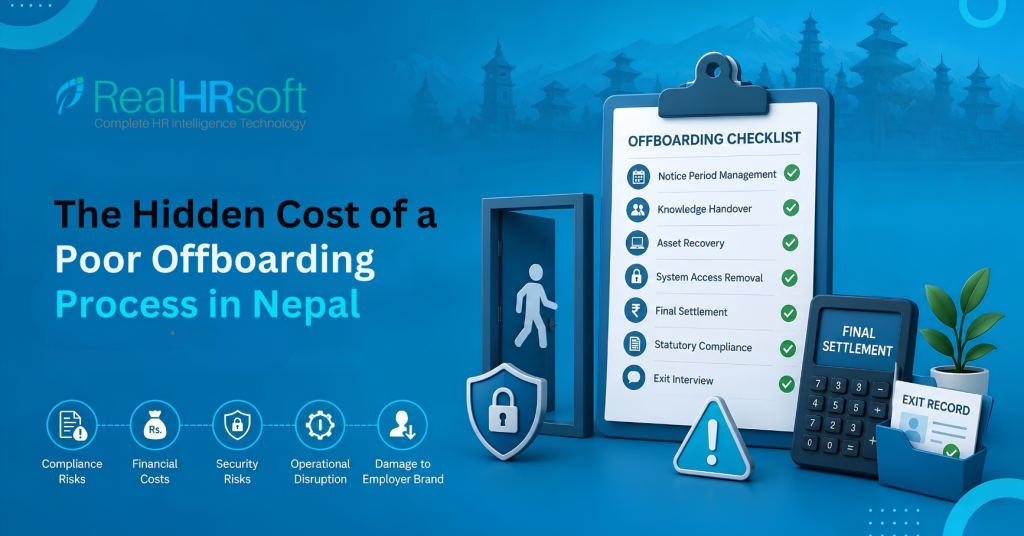
A proper offboarding process covers notice period management, knowledge handover, asset recovery, system access removal, final settlement calculation, statutory compliance, documentation, and the exit interview. Skip any one of these, and the exit is incomplete even if it looks finished on paper.
The Hidden Costs of Poor Offboarding
1. Compliance Risks
Nepal’s Labour Act, 2074 and Labour Rules, 2075 set out specific obligations employers must meet when an employment relationship ends from notice periods and final settlement timelines to accurate calculation of accrued leave, gratuity, and provident fund dues. When offboarding is handled informally, these obligations are easy to miss.
It creates gaps such as:
- Missing documentation — no signed clearance form, no record of the exit interview, no proof that statutory dues were calculated correctly.
- Inaccurate final settlements — leave encashment, provident fund, and gratuity figures calculated manually, with no audit trail if the employee disputes the amount.
- Incomplete leave calculations — carried-forward leave, unused sick leave, or festival leave balances that don’t reconcile with attendance records.
- Statutory compliance gaps — no evidence of adherence to notice period rules or termination procedures under the Labour Act, which becomes a liability if the exit is ever challenged at the Labour Office.
2. Financial Costs
An unstructured exit process increases the risk of payroll errors, unrecovered company assets, duplicate administrative work, and costly disputes.
It creates issues such as:
- Payroll errors — final settlements calculated by hand, using outdated salary structures or missed deductions, often needs to be corrected
- Unrecovered company assets — laptops, phones, ID cards, and access cards that are never formally logged as “returned” becomes a write-off.
- Duplicate administrative work — without a checklist, different departments (HR, IT, Finance, Admin) each try to track the same exit independently, wasting hours reconciling each other’s work.
- Disputes — an employee who feels underpaid in their final settlement is prone to filing a Labour Office complaint, dragging out a simple exit into an expensive legal issue.
3. Security Risks
Failure to deactivate system access and recover company accounts or devices can expose confidential information, client data, and internal systems to unnecessary security and privacy risks. When system access isn’t deactivated and company accounts or devices aren’t recovered on the employee’s last working day, the organization is risking a lot.
- Former employees retaining access to email, CRM, HRIS, or shared drives after their exit is far more common than most organizations realize.
- Confidential information, client data, and internal systems remain exposed for as long as that access stays active which could be days, weeks, or, in poorly tracked cases even months.
- Devices that aren’t recovered or revoked can carry sensitive data outside the organization’s control entirely.
4. Operational Disruption
Without a structured handover, valuable knowledge is lost, projects face delays, clients experience disruptions, and managers spend additional time reconstructing unfinished work. Knowledge doesn’t leave gradually, it leaves the moment the employee resigns without proper handovers.
- Without a structured handover, ongoing projects lose their institutional memory: who the client contact is, why a certain decision was made, where a file actually lives.
- Clients or vendors who were used to working with that employee experience a visible gap in continuity.
- Managers end up spending days, sometimes weeks reconstructing unfinished work instead of focusing on their actual responsibilities, because there was no formal handover document or transition period built into the exit process.
5. Damage to Employer Brand
A poor exit experience such as delayed settlements, unclear clearance procedures, or unprofessional communication can harm an organization’s reputation and negatively affect future recruitment. Exits are remembered, and in a small professional market, word travels fast. A delayed final settlement, an unclear clearance process, or an unprofessional last conversation doesn’t just affect the departing employee, it also shapes how current employees perceive the organization’s integrity.
- Delayed settlements are one of the most common sources of negative reviews from former employees.
- Unclear clearance procedures create a frustrating, disorganized last impression.
- Poor communication during the exit such as- no acknowledgment, no professionalism signals to remaining employees how little the organization values people once they’ve decided to leave.
How RealHRsoft Helps
Instead of leaving offboarding to scattered emails and manual follow-ups, RealHRsoft’s Onboarding/Offboarding module kicks in automatically the moment a resignation is approved triggering a structured task flow that covers clearances, exit surveys, and final settlement, all visible in one place from start to finish.
Role-Based Access Control links system access directly to employment status, so HR and IT can revoke accounts the instant separation is confirmed closing the security gap that informal exits usually leave wide open. Meanwhile, the Payroll Automation Module calculates the final settlement including leave encashment using the same statutory rules applied throughout employment, removing the manual calculation errors that so often escalate into disputes.
Conclusion
Offboarding is often treated as the least strategic part of HR. Some organizations treat offboarding as the paperwork to clear before moving on to the next hire. But it’s actually the clearest test of how mature an organization’s HR function really is. Recruiting looks good when the market is calm. Onboarding looks good when there’s a checklist and a welcome kit. Offboarding is what happens under pressure, on a deadline, with real legal and financial consequences attached to every step and it’s where informal processes get exposed fastest.
None of the risks in this article are hypothetical. A missed leave encashment calculation becomes a Labour Office complaint. An account left active becomes a data exposure. A rushed handover becomes weeks of a manager’s time spent reconstructing lost context. Each of these starts small and compounds quietly until something forces it into the open dispute, an audit, a resignation that exposes just how much depended on informal memory.
The fix isn’t asking HR to be more careful. It’s building a process that doesn’t require anyone to remember anything where a resignation triggers the same structured, compliant workflow every time.
Automate your employee exit process — see how RealHRsoft turns offboarding into a tracked, compliant workflow.