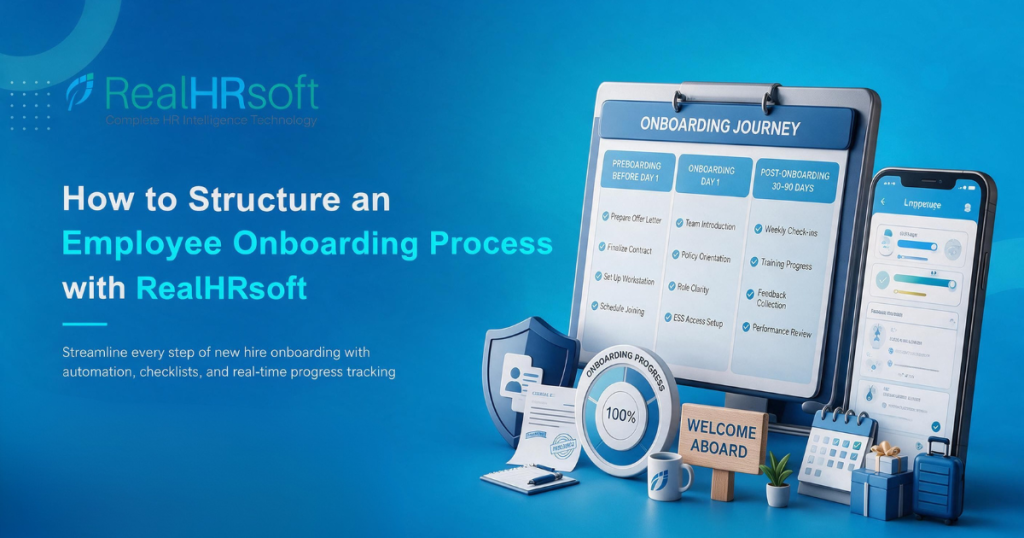
How to Structure an Employee Onboarding Process with RealHRsoft
Overview
A new employee joining an organisation involves much more than a single HR activity.
An offer needs to be prepared, employment documents completed, employee information recorded, system access and equipment arranged, managers informed, and the employee introduced to their role and the organisation.
When these activities are managed through spreadsheets, emails, messages, paper forms, and individual follow-ups, onboarding can quickly become dependent on HR remembering what needs to happen and who needs to do it.
A well-structured onboarding process creates a different experience. Employees know who they report to, what is expected of them, which activities they need to complete, and where to find the information and resources they need.
Onboarding should also introduce employees to the organisation’s culture, values, communication practices, and ways of working. This helps new employees become comfortable, build relationships, and understand not only what they need to do, but how work gets done.
This is why onboarding should be treated as a structured and repeatable process, not just a checklist.
Start by Structuring Onboarding into Three Stages
Before automating onboarding, organisations should first define what needs to happen and when. A practical onboarding process can be divided into three stages
1. Preboarding: Prepare Before the Employee Arrives
Preboarding covers the activities that should be completed before the employee’s first day. The objective is simple: make sure the organisation and the employee are ready to start. Typical activities include:
- Prepare and issue the offer letter
- Complete employment contract and signing
- Create the employee record
- Collect employee information
- Assign the reporting manager
- Prepare equipment and workstation
- Arrange email and system access
- Inform relevant departments
- Prepare the joining schedule
Defining these activities in advance reduces last-minute follow-ups and makes the joining process more organised.
2. Onboarding: Help the Employee Get Started
Once the employee joins, the focus shifts to helping them understand the organisation, their role, their responsibilities, and how work gets done.
Activities may include:
- Introduce the employee to the manager and team
- Provide organisation and department orientation
- Explain responsibilities and expectations
- Introduce relevant policies and procedures
- Complete required training
- Set up attendance and payroll information
- Provide Employee Self Service (ESS) access
- Allow employees to update their profile and information
This stage should give employees enough clarity to start working confidently and understand how their role connects with the wider organisation.
3. Post-Onboarding: Follow Up
Onboarding should not end when the employee completes their first day. A short follow-up process helps identify anything that is incomplete and gives the employee an opportunity to raise questions.
Depending on the organisation, post-onboarding activities may include:
- First-week check-in
- Manager follow-up
- Completion of pending training, or documents
- Employee feedback
- Initial performance discussion
- Probation follow-up
- 30-day review
This turns onboarding from a one-time administrative activity into an ongoing process of helping a new employee settle into the organisation.
Turn the Process into Reusable Task Templates
- Once the stages are defined, the next step is to turn them into tasks.Instead of creating a new checklist every time someone joins, organisations can define common onboarding tasks once
- and reuse them.For example:
| Stage | Task | Responsibility | Timing |
|---|---|---|---|
| Preboarding | Prepare offer letter | HR | Before joining |
| Preboarding | Complete contract signing | HR / Employee | Before joining |
| Preboarding | Create employee record | HR | Before joining |
| Onboarding | Prepare equipment | Admin / IT | Before joining |
| Onboarding | Conduct orientation | HR | Day 1 |
| Onboarding | Introduce employee to team | Manager | Day 1 |
| Onboarding | Complete role orientation | Manager | First week |
| Post-Onboarding | First-week check-in | Manager | First week |
| Post-Onboarding | Review onboarding progress | HR | First month |
The exact tasks will differ by organisation, department, and position. The important point is to define the process once and make it reusable.
How RealHRsoft Helps Run the Process
RealHRsoft helps turn the defined onboarding process into a structured workflow rather than leaving it across different files, emails, and follow-ups.
Create the Employee Record
The employee record provides a central place for employee information. Once the employee is added, relevant information can be used throughout the employee lifecycle, reducing repeated data entry.
Manage Offer Letters and Contracts
Organisations can use standardised templates for employment letters and contracts, with employee information populated from the employee record. This helps make documentation more consistent and reduces repetitive preparation.
Create and Run Role-Based Onboarding Tasks
Not every employee needs the same onboarding process. An intern may need a simple orientation, while a manager may require additional responsibilities, access, and training.
RealHRsoft allows organisations to create multiple onboarding templates based on role, department, or employee requirements and reuse them for new hires.
Tasks can be assigned to HR, IT, Admin, managers, or employees, ensuring each person follows the onboarding process relevant to their role.
Let Employees Complete Their Own Information
Through Employee Self Service, employees can access relevant information and update their profile where applicable. This reduces the need for HR to collect every piece of information manually and helps keep employee records up to date.
Assign Responsibilities and Deadlines
A good onboarding process is not only an HR responsibility. Different activities may belong to HR, IT, Admin, the manager, or the employee.
Assigning tasks to the responsible person with clear deadlines creates accountability and reduces the need for HR to repeatedly ask, “Has this been completed?”
Track Onboarding Progress
HR can track completed and pending activities and identify where attention is required. This gives HR better visibility into the onboarding process without relying on separate spreadsheets or manual status updates.
Why Structured Onboarding Matters
A structured onboarding process helps organisations achieve more than a smoother first day.
It creates:
- Consistency — every employee follows a defined process
- Accountability — responsibilities are clearly assigned
- Visibility — HR can see what is completed and what is pending
- Less follow-up — fewer manual reminders and status checks
- Better employee experience — employees receive clearer guidance
- Scalability — the process can be repeated as the organisation grows
Most importantly, the process becomes part of the organisation rather than depending on one HR person remembering what needs to be done.
From Joining to Becoming Part of the Organisation
Onboarding brings together many activities that need to happen at different stages and involve different people.
Offer → Contract → Employee Information → Preboarding → First Day → Role Orientation → Employee Self Service → Follow-Up
When these activities are connected through a defined process, everyone knows what needs to happen, who is responsible, and when it needs to be completed. HR gets better visibility, managers have clearer responsibilities, and employees get a more organised start.
RealHRsoft brings employee information, documents, onboarding tasks, responsibilities, and follow-up together in one system. Instead of managing each new hire from scratch, organisations can create a process once and use it consistently for every new employee.
The goal is not simply to replace a manual checklist with software. It is to make onboarding a defined part of how the organisation works—consistent, accountable, repeatable, and easier to manage as the organisation grows.
Give Every Employee a Better Start
Onboarding shouldn’t rely on HR remembering everything every time someone joins. Define the process once, assign it consistently, and see exactly where every new hire stands.
See how RealHRsoft can help you structure, manage, and track onboarding from offer to post-onboarding.