How to Run a Structured Exit Process in Nepal
In every organization, employees resign or employment contracts come to an end. The way a company manages the exit process often highlights the strength and maturity of its HR operations.
A poorly managed exit process creates risks such as unreturned company assets, active system access left, incomplete knowledge transfer, delayed final payments, and even disputes. For HR managers and business owners in Nepal, a structured exit process is more than just an administrative requirement. It is an essential risk management practice for both the organization and the departing employee.
Best Practices for Running a Structured Exit Process in Nepal
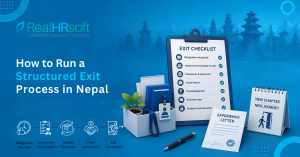
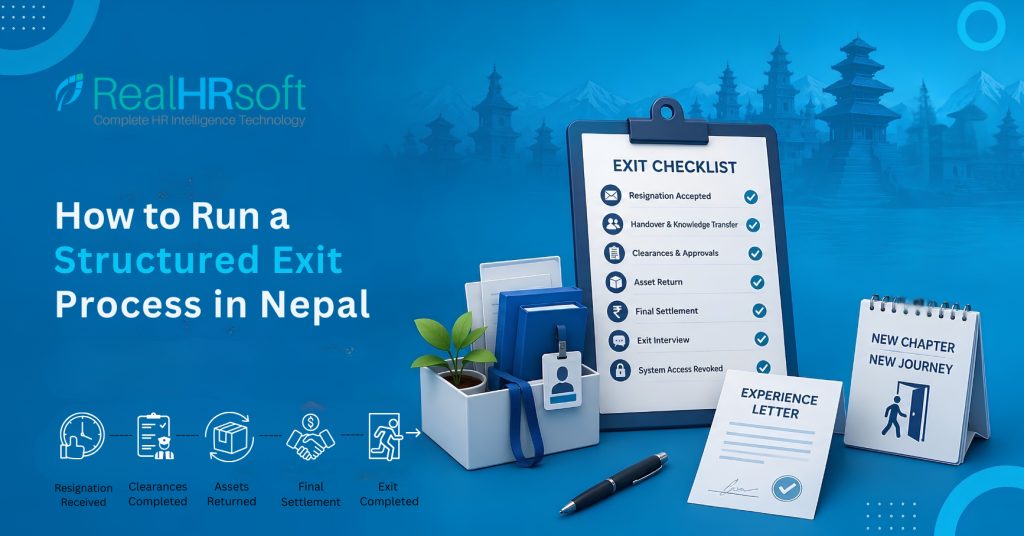
- Build a standardized exit checklist: Prepare a structured exit checklist to remove confusion and prevent disputes. The checklist should cover the complete journey from receiving the resignation to completing the final settlement. It may include resignation acknowledgement, notice-period confirmation, knowledge transfer, department clearance, asset return, leave-balance verification, finance clearance, IT access removal, exit interview, final settlement, and issuance of relevant employment documents.
- Communicate clearly with the departing employee: Put final dates, notice terms, leave balances, and payment details in writing. Once a resignation is received, HR should clearly communicate the next steps to the employee. This should include the resignation acceptance status, expected last working day, applicable notice-period requirements, pending leave information, handover expectations, clearance requirements, and the expected process for final payment and documentation.
- Complete documentation and approvals on time: Process resignations and clearances promptly through a defined sign-off chain. HR should maintain the resignation letter, acceptance or acknowledgement, handover documents, clearance forms, asset-return records, exit interview information, and final settlement documents in an organized manner. Different departments may also have specific responsibilities. For example, the employee’s manager may confirm knowledge transfer, IT may verify system and equipment clearance, Finance may verify financial obligations, and Administration may confirm physical asset returns.
- Conduct exit interviews: Systematically collect feedback to identify retention and management issues. A structured exit interview gives HR an opportunity to understand why employees are leaving and identify patterns that may otherwise remain hidden.
HR can ask about:- Reason for leaving
- Compensation and benefits
- Relationship with managers
- Work environment
- Career development opportunities
- Workload and responsibilities
- Organizational culture
- Employee engagement
- Suggestions for improvement
- Manage final settlements accurately: Correctly calculate final pay and leave cash-outs. HR and Finance should carefully verify the employee’s salary, applicable deductions, outstanding advances or loans, leave balances, reimbursements, benefits, and other applicable components before preparing the final settlement. Leave balances should be reviewed according to applicable law and the organization’s approved policies. Any applicable statutory or contractual payments should also be calculated accurately.
The organization should avoid last-minute calculations based on spreadsheets or incomplete records. A clear final-settlement statement should help the departing employee understand how the final amount was determined. - Recover company assets and revoke system access: Collect physical equipment and disable digital access by the employee’s last day at work. Before the employee’s final working day, HR should coordinate with the relevant departments to confirm the return of company property such as laptops, desktops, mobile phones, ID cards, access cards, keys, documents, equipment, and other assigned assets.
- Maintain complete employee records: Archive contracts, sign-offs, and payout records for compliance and reference checks. Records may include the resignation letter, employment documents, clearance approvals, asset-return confirmation, exit interview, final settlement information, experience or service documentation, and other relevant records.
How HR Technology Can Improve Exit Management
-
- Automate the workflow from resignation submission to final clearance.
- Assign exit tasks to HR, managers, IT, Finance, and Administration.
- Route digital approvals between departments.
- Track pending clearance tasks and deadlines.
- Maintain employee documents in a centralized HRIS.
- Record exit interviews and employee feedback.
- Track company assets assigned to employees.
- Coordinate final payroll and settlement information.
- Maintain historical employee records after separation.
- Generate reports for HR analysis and management review.
How RealHRsoft Helps
- RealHRsoft’s Offboarding module automates the entire exit process so resignation, clearances, asset return, and exit survey can be carried out within the HRIS.This module helps to organize the employee’s exit journey, including resignation, clearance, handover, asset return, and exit-related activities within the HRIS.
- The Payroll Automation Module calculates the final settlement, leave balances, unpaid salary, and statutory deductions with zero manual computation. This module can support the calculation and management of final payroll information, including salary, leave balances, unpaid amounts, and applicable deductions, reducing dependence on separate manual spreadsheets.
- The HRIS Document Management module keeps every resignation letter, clearance form, and experience letter stored and retrievable for every employee who has left the organization. This module can also help HR teams maintain resignation letters, clearance documents, experience letters, and other employee records in a centralized and retrievable location.
Conclusion
A structured exit process simplifies a complex offboarding by prioritizing clear updates, standardized records, precise payouts, and timely asset recovery. If your current exit management still relies on manual tracking, spreadsheets, and memory, now is the time to modernize before the next resignation comes in. A strong offboarding process should provide clear communication, proper documentation, knowledge transfer, accurate final settlement, asset recovery, system-access control, meaningful exit interviews, and secure record management.
For growing organizations, continuing to manage employee exits through spreadsheets, emails, paper forms, and memory can create unnecessary delays and risks. Moving to an HRIS can help standardize the process and give HR better visibility over every pending exit activity.
If your organization is still managing employee exits manually, now may be the time to modernize your employee offboarding process.
Ready to automate your employee exit process? — 👉 Book a RealHRsoft Demo Today.