Overtime Rules in Nepal — What Employers Must Pay
Most Nepal employers know overtime exists. Far fewer know exactly what the law requires them to pay, when the obligation kicks in, and what happens when they get it wrong. The gap between “we pay a bit extra for late hours” and full compliance with the Labour Act 2074 is where penalties, backpay orders, and labour disputes are born.
This article covers overtime rules and the rate your HR and payroll team needs to stay compliant.
What Are the Overtime Rules in Nepal Under Labour Act 2074?
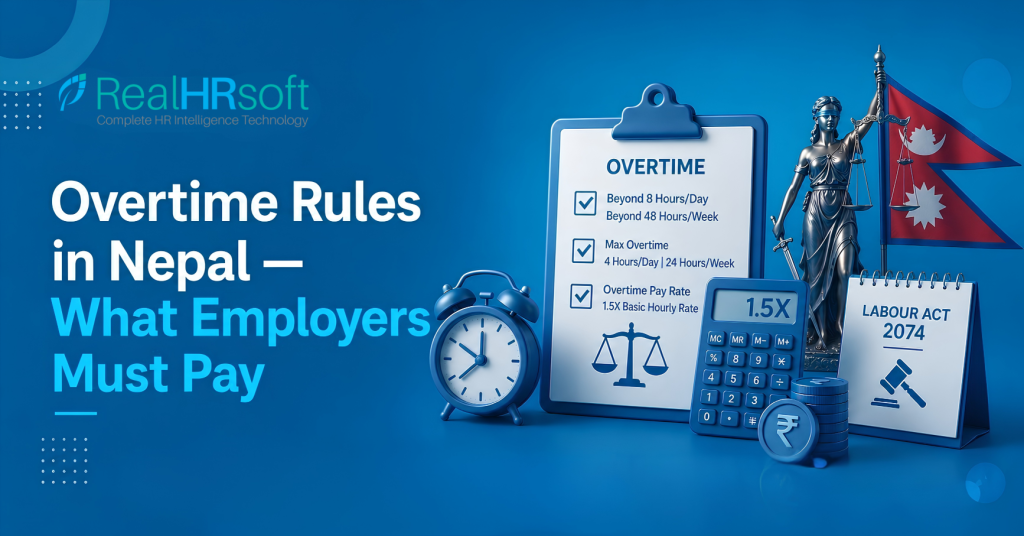
Overtime is any authorised work performed beyond the standard statutory working hours defined under Section 28 of the Labour Act 2074 (2017). The standard thresholds are:
- 8 hours per day
- 48 hours per week
Any work beyond these limits provided it is authorised is legally classified as overtime and must be compensated at the statutory premium rate. The 30-minute rest break mandated after every five consecutive hours of work does not count toward the 8-hour active shift. It is excluded from the calculation. This applies to all enterprises operating in Nepal regardless of size, startups, manufacturing units, NGOs, INGOs, IT companies, and corporate entities alike.
The Labour Act does not simply require overtime pay it caps how much overtime is legally permissible. These are not guidelines. They are statutory ceilings.
| Timeframe | Maximum Lawful Overtime | Total Allowable Shift Length |
|---|---|---|
| Daily | 4 hours | 12 hours total per day |
| Weekly | 24 hours | 72 hours total per week |
Even if an employee voluntarily agrees to work more than 4 hours of overtime in a single day, the employer remains fully liable. Employee consent cannot override the legal daily limit. Exceeding this cap places the organization in direct violation of the Labor Act, regardless of whether the employee objected or not.
Who Is Eligible for Overtime Pay?
Nepal’s Labour Act protects almost everyone including regular, part-time, project-based, and casual staff. If they work past the legal hours, they must be paid overtime. However, there are two major exceptions you need to know:
- Managers and Executives: Top-tier bosses, directors, and CEOs generally do not get overtime pay. The law assumes their higher salaries already cover the extra hours needed to run the company. Just remember: this exception must be explicitly written into their employment contract; you cannot just assume it applies informally.
- Overtime Must Be Voluntary: Under Section 29, you cannot force anyone to work extra hours unless it is a genuine business emergency to prevent a major loss. Outside of emergencies, overtime is a choice. If an employee claims they were forced to work late, the government will side with them unless you can prove they agreed to it willingly.
Public Holidays and Weekly Rest Days: A Separate Obligation
Working on Saturdays or public holidays is where many companies in Nepal make payroll mistakes.
According to Section 30(2) of the Labour Act, if you ask an employee to work on a holiday or their regular day off, you have only two legal choices:
- Give them a substitute day off within the next 21 days.
- If you can’t give them a replacement day off within that 3-week window, you must pay them overtime at 1.5 times their basic hourly rate.
A lot of employers think there is a special, separate calculation for holiday pay. There isn’t. The rule is simple: either give them a replacement day off within 21 days, or pay them the standard 1.5x overtime rate. If you do neither, you are breaking the law.
Employer Record-Keeping Obligations
During a labor audit, the burden of proof regarding overtime compliance rests completely on the company, not the employee. The Department of Labour and Occupational Safety (DoLOS) can conduct unannounced site inspections so employers must have verifiable attendance and payroll records ready at all times. You must be able to produce:
- Verified attendance records timestamped login and logout data reflecting actual hours on premises or in the field
- Overtime authorisation documentation a documented trail showing managerial approval before or at the time the overtime was worked
- Payslips with overtime separated monthly wage documents showing basic salary, allowances, SSF deductions, and overtime as distinct, labelled line items with hours and rate visible
- Consent records evidence that overtime was voluntary or, in emergency cases, documentation of the nature of the emergency
If any of these are missing during an audit, the assumption runs against the employer. Reconstructed records assembled after the fact from memory or informal notes — carry no standing in a labour dispute.
The 5 Most Common Overtime Mistakes Nepal Employers Make
- Calculating from gross salary instead of basic salary- This is the most widespread calculation error. Always use basic remuneration as the base. Non-guaranteed allowances do not enter the formula.
- Treating overtime as informal- Employees staying late without a documented request, approval, and claim record. This creates an undocumented liability. If an employee later files a complaint, the employer has no trial and no defence.
- Ignoring the weekly cap- The 24-hour weekly ceiling is frequently unknown at the manager level. Line managers schedule overtime without tracking cumulative hours, and HR only discovers the violation at month end.
- Missing the substitute leave window for holiday work- Employers offer a replacement day informally — but never within the 21-day window the law requires. After 21 days, the obligation converts to overtime pay. Most employers do not even know the window exists.
- Merging overtime into a “miscellaneous allowance”- This is both a payslip compliance failure and an audit red flag. Overtime must be shown separately, with hours and rate. A merged allowance line cannot be verified by an inspector or challenged by an employee.
How RealHRsoft Helps
Managing overtime under Nepal’s laws isn’t a “set-and-forget” task. Every new hire, shift change, and public holiday makes payroll tracking more complex. Trying to manage this manually with spreadsheets and verbal agreements is exactly how compliance slip-ups happen.
This is where RealHRsoft steps in. RealHRsoft is built to handle this systematically. Rather than leaving HR teams to manually piece together attendance data, chase approvals, and calculate rates each month, the platform converts Nepal’s overtime obligations into automated workflows that run in the background so HR can focus on people, not the paperwork.
RealHRsoft’s Attendance Module and Payroll Automation Module convert every overtime rule above into an automated, auditable workflow:
- The Attendance Module captures work hours directly from biometric devices (ZKTeco, HikVision) or geo-tagged mobile check-ins, routes overtime requests through a documented pre-approval workflow aligned with Section 29 of the Labour Act, and flags employees approaching the 4-hour daily or 24-hour weekly cap in real time before a violation occurs.
- The Payroll Automation Module pulls approved overtime data automatically at payroll run, applies the correct calculation using basic salary as the base, generates the 1.5x rate without manual input, and produces payslips with overtime shown as a separate line item hours, rate, and total exactly as the Labour Act requires.
- For organisations with field staff or travel-based teams, the Travel Attendance feature ensures remote overtime hours are captured with geo-location verification, not self-reported estimates.
Every overtime record like approvals, attendance entries, payroll calculations, payslips is stored in one place. No last-minute scramble at month end. No cross-checking between separate systems. If the Department of Labour and Occupational Safety inspects without notice, everything they need is already there.
For HR teams, that means less time chasing paperwork and more time on work that actually matters like planning, performance, and strategy.
Compliance Disclaimer
This article is based on the Labour Act 2074 (2017) and Labour Rules 2075 (2018). Statutory provisions are subject to change. This content is for general informational purposes only and does not constitute legal advice. Verify current provisions with the Department of Labour and Occupational Safety (DoLOS) before taking action. For entity-specific compliance obligations, consult a qualified labour law practitioner.
Stop Letting Manual Overtime Tracking Create Compliance Gaps
Every payroll cycle you process overtime manually is a cycle where calculation errors, missing approvals, and undocumented consent accumulate. The liability is silent until an employee files a complaint or an inspector arrives.
Automate your overtime compliance and protect your business from penalties you could have prevented.
 Book a Demo ! See how RealHRsoft’s Attendance Module and Payroll Automation Module handle every overtime rule in the Labour Act 2074, automatically.