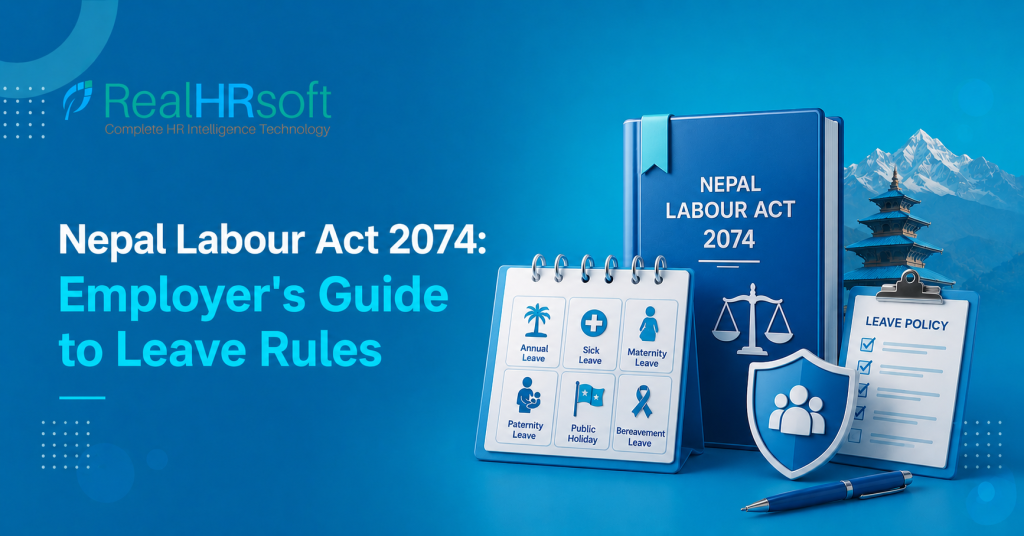
Nepal Labour Act 2074: Employer's Guide to Leave Rules
The Labour Act 2074 sets the minimum leave entitlements every employer in Nepal must provide — home leave, sick leave, maternity and paternity leave, mourning leave, and public holidays. These are not benefits an employer chooses to offer; they are statutory minimums, each with its own accrual rate and cap written into law.
Who It Applies To
Every employer with employees under a contract of employment in Nepal, regardless of company size or sector. Entitlement depends on employment category:
- Regular, Time-Bound, and Work- Based Employees — full, pro-rata statutory leave allocations as set out below, based on days worked.
- Part-Time Employees — those working 35 hours or less per week receive leave benefits calculated proportionately to their working hours.
- Casual Employees —those working 7 days or less in a month are exempt from standard statuory leave accruals, as they donot maintain a continuous employment relationship.
Key Rules
| Leave Type | Statutory Allowance | Accumulation / Carry-Forward | Labour Act 2074 Section |
|---|---|---|---|
| Weekly Rest | 1 day per week | Cannot be accumulated | Section 40 |
| Public Holidays | 13 days (male) / 14 days (female, includes International Women’s Day) | Cannot be accumulated | Section 41 |
| Home (Annual) Leave | 1 day for every 20 days worked | Up to 90 days | Section 43 |
| Sick Leave | 12 days per year, fully paid | Up to 45 days | Section 44 |
| Maternity Leave | 98 days (14 weeks); employer pays in full for the first 60 days | N/A | Section 45 |
| Paternity Leave | 15 days, fully paid | N/A | Section 45(6) |
| Mourning Leave | 13 days, fully paid | N/A | Section 48 |
How RealHRsoft Helps
RealHRsoft’s Leave Management module lets HR configure each leave type — Home Leave, Sick Leave, Maternity, Paternity, Mourning — as a separate Leave Rule under Leave Master Settings, with the accrual rate, cap, and carry-forward behaviour set once and applied automatically to every employee assigned that rule.
The Organization Holidays List supports customisation by demographic, branch, or department — which is exactly what the male/female public holiday split requires, rather than forcing every employee onto one calendar.
The Leave Fiscal Year setting aligns leave balances to the BS calendar by default, so resets happen on Shrawan 1, not January 1. Leave Encashment is tracked as its own workflow (Leave > Leave Encashment), so eligible unused leave is calculated and processed before the new year’s balances are applied.
Before: HR tracks each employee’s leave accrual and caps manually in a spreadsheet, manages a single public holiday calendar regardless of gender, and recalculates maternity pay liability by hand each time.
After: RealHRsoft accrues leave automatically against each configured rule, applies the correct holiday calendar by demographic, and flags balances approaching the cap without manual recalculation.
Managing employee leave should be simple, accurate, and fully compliant with Nepal’s Labour Act—not dependent on spreadsheets and manual calculations. With RealHRsoft’s Leave Management Module and Employee Self Service (ESS) Portal, you can automate leave policies, streamline approvals, maintain complete audit trails, and generate accurate leave balances and encashment reports with ease.
Book a personalized demo today to see how RealHRsoft can simplify leave management, improve compliance, and save valuable HR time.
RealHRsoft | Emphasize Strategy. Automate HR. | A Product of Aayulogic
Note:
This article is for general informational purposes only and does not constitute legal advice. Laws and regulations are subject to change. Consult a qualified legal or tax professional for advice specific to your situation. Always verify current rates and deadlines at ird.gov.np and ssf.gov.np.