In today’s competitive and fast-evolving business environment, organizational structure plays a critical role in determining how effectively a company operates. For many Nepali organizations, challenges such as unclear reporting lines, overlapping responsibilities, and delayed decision-making often stem not from a lack of talent, but from poorly defined job hierarchies.
Designing a clear, well-aligned organizational chart (org chart) is not merely an administrative task. It is a strategic HR and business decision that directly impacts productivity, accountability, and long-term growth.
Understanding Organizational Structure
An organizational structure defines how roles, responsibilities, authority, and communication flow within a company. Many businesses in Nepal begin with informal structures that work well for small teams. However, as organizations grow from five employees to fifty or more, this informality often leads to confusion and inefficiency.
Common structural challenges seen in organizations may include:
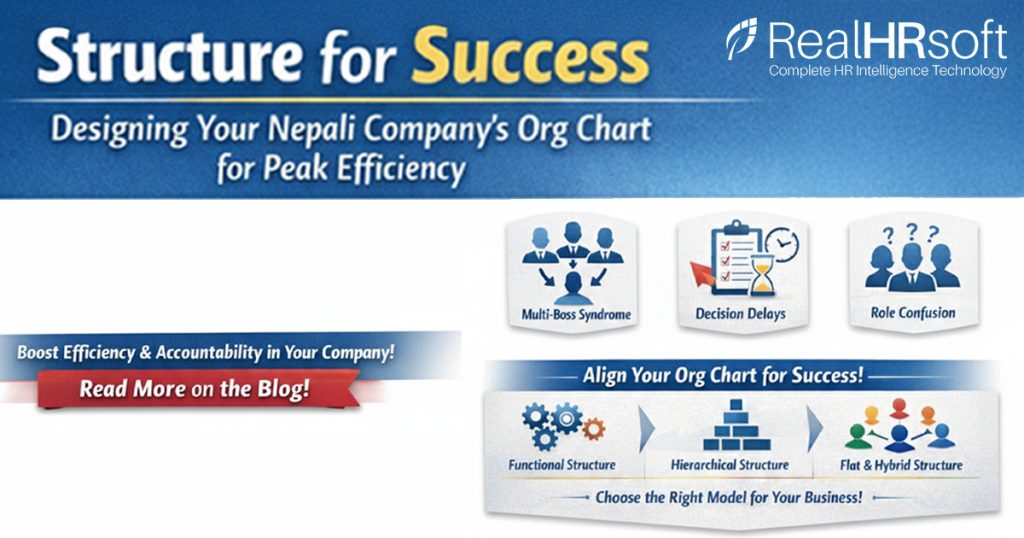
- Multi-Boss Syndrome: Employees report to multiple managers without clear authority or priority, leading to confusion and conflicting instructions.
- Decision-Making Bottlenecks: Even routine or minor decisions require top-level approval, slowing down operations.
- Role Ambiguity: A “everyone does everything” culture that weakens accountability and ownership.
Without a clearly documented structure, these issues can quietly erode efficiency and employee morale.
Aligning Organizational Structure with Business Goals
An effective organizational structure should serve as the vehicle that carries your business strategy forward. The right structure depends heavily on what the organization is trying to achieve.
Companies aiming for rapid market expansion often benefit from decentralized or divisional structures that allow faster local decision-making and responsiveness. Organizations focused on operational excellence and cost control typically perform better with functional structures, where specialization and centralized processes improve efficiency. Meanwhile, businesses that prioritize innovation, collaboration, or agility such as tech startups or creative firms may find flat or hybrid structures more effective, as these encourage cross-functional teamwork and faster execution.
When organizational design aligns with strategic goals, the hierarchy supports growth rather than restricting it.
Choosing the Right Organizational Structure
1. Functional Structure
Employees are grouped based on specialization, such as HR, Finance, Operations, or Sales.
Best suited for: Large to mid-sized Nepali firms with stable operations.
Key advantage: High technical expertise and clear functional accountability.
2. Hierarchical Structure
A traditional top-down system with clearly defined authority levels and reporting lines.
Best suited for: Large organizations, government bodies, or traditional corporations needing clear command, defined roles, and controlled growth , providing stability but risking slow decisions.
Key advantage: Strong control, accountability, and clarity in command.
3. Flat or Hybrid Structure
Fewer management layers with broader responsibilities and shared ownership.
Best suited for: Startups and modern companies promoting agility and collaboration.
Key advantage: Faster communication and empowered employees.
Designing Clear Job Hierarchies and Supporting HR Policies
A successful org chart is as strong as the job descriptions behind it. Every role in the structure should clearly define:
- A standardized job title
- Core responsibilities and scope
- Reporting relationships
- Decision-making authority
- Performance indicators linked to business outcomes
Formalizing these elements through HR policies and procedures is very important. Documented guidelines help ensure consistency, transparency, and fairness particularly during promotions, transfers, and performance evaluations.
An Information Portal or Employee Handbook further strengthens this process by ensuring employees understand how the structure works and what is expected of them.
Common Organizational Design Mistakes to Avoid
While designing or revising organizational structures, Nepali companies should avoid:
- Copying org charts from multinational companies without contextual adaptation.
- Inflating job titles without assigning real authority.
- Creating unnecessary layers that slow down decisions.
- Designing structures only for today’s needs and ignoring future growth.
A well-designed structure should be flexible enough to evolve while remaining clear and stable.
Final Thoughts
A thoughtfully designed organizational structure is the foundation of sustainable business success. For the companies in Nepal, moving from informal management practices to clearly defined hierarchies is a critical step toward professionalization and efficiency.
If your organization is experiencing confusion in roles, approval delays, or accountability gaps, your org chart may be the root cause.
Take time to review and refine your organizational structure because clarity today builds stronger performance tomorrow.
Reach out to us to help you handle it right through our expert HR consulting services!
📧 info@aayulogic.com
📞 +977-9802-075555